
.svg)
.svg)

Search engine optimization (SEO) can sometimes feel like a never-ending chess game between you and the algorithms. You tweak a few keywords or redo your site’s layout, and your content starts to climb. Then the algorithm changes, and your site drops down nine spots, and on and on.
But it’s not just a 1v1 game, as video game fans would say. Your competitors are studying the algorithm, too, and trying just as hard to rank. And sometimes, they use keywords that haven’t even made it on your radar. Or maybe they’re missing a newly in-demand keyword that you could snag first (finders keepers).
Competitor keyword research can help you spot these growth opportunities and put them to good use. But you’ll need to do more than scope out their blog posts or study their landing pages. Here’s how to get the skinny on your competitors’ SEO strategy — and use your new intel to beef up your online presence.
Identify Who Your True Competitors Are
You probably already have a keen sense of who your business competitors are. For example, your small business might have an arch-nemesis across town that’s trying to siphon away your customers. Or your e-commerce site might sell dresses or gardening supplies that are similar to another business’s products.

However, these brands might not be your search competitors. That status is reserved for creators who rank for the same search queries. A Google search for “gardening tips for beginners,” for instance, returns results from Miracle-Gro, a plant food company, and the Academy of Nutrition and Dietetics — not the competition you might expect.
Spotting your competitors is the first step to learning how to do keyword research. Just search for a few seed keywords related to your business — like “wedding planner” or “floral skirt” — and see who keeps showing up.
Evaluate Their Content and SEO Presence
Peruse your competitors’ content with an eye for structure. Do they have engrossing blog posts? Fancy animated videos? Snazzy infographics? Pay attention to any standout content, like that well-researched white paper everyone’s backlinking to.
Of course, a thorough competitor analysis also needs hard data. Use something like Moz or SEMrush’s Backlink Analytics tool to audit their sites for:
- Backlinks: Content that’s linked by other sites — like a how-to guide for choosing a wedding dress — might be worth reverse-engineering for yourself.
- Authority score: Not as credible as your competitors? Maybe you need to focus on earning backlinks or citing better sources.
- Search visibility: Jot down all your competitors’ top-ranking keywords. Where are they beating you? Do you see any totally unexpected terms?
Choose the Right Tools for Keyword Research
Keyword research tools can help you analyze every part of your competitors’ sites, but they’re not all created equal.
Google Keyword Planner
- Pros:
- Free
- Shows keyword difficulty
- Cons:
- Only accessible with a Google Ads account, which takes time to set up
- No competitive keyword analysis tools
SEMrush
- Pros:
- Traffic analytics with daily and weekly comparisons
- Social media tracking tools
- Free keyword finder tool
- Cons:
- Paid plans are expensive
Moz
- Pros:
- Affordable
- Keyword Gap tool shows where competitors outrank you
- Compares keyword ranking distribution
- Cons:
- Doesn’t estimate site traffic
Analyze Top-Performing Pages
You don’t need to go full Sherlock Holmes to do a thorough keyword competitor analysis. Instead of scrutinizing every piece of content they’ve published (exhausting), use a tool like SEMrush to generate keyword research reports for their most high-traffic pages.
Channel your inner hacker by reverse-engineering their top pages to learn their content strategy. Look at their keyword rankings first to see what’s bringing in traffic — any niche keywords or less competitive short-tail keywords you can swoop in on? Backlinks can also show what other people find valuable.
Spot Patterns in High-Ranking Content
Dissect your competitor’s top pages thoroughly to look for trends — or ask an AI tool like ChatGPT to do it for you. Pay attention to:
- Recurring themes, like pun-filled listicles or snarky product comparisons
- Similar formats, such as FAQ sections packed with valuable keywords
- Especially eye-catching meta descriptions, headers, and other on-page SEO tactics
Uncover Keyword Gaps and Missed Opportunities
Tools like SEMrush and Moz make keyword research competitor analysis... well, not exactly a breeze, but easier. Just plug in your site and a few top rivals, and see how your top keywords stack up.
Look for keywords that reveal content gaps in your site. For example, a competing flower shop may rank for “how much to tip wedding florist,” while you don’t have any practical tips like that — yet. Prioritize long-tail keywords here, which may be easier to rank for.
You can also use Google Trends to find the hottest search terms of the moment. These trends might spark keyword ideas that haven’t even crossed your competitors’ radar, giving you a head start in the rankings race.
Filter by Difficulty and Volume for Smart Wins
Many keyword research and competitor analysis tools let you sort opportunities by difficulty and search volume. Here’s what that looks like with SEMrush:
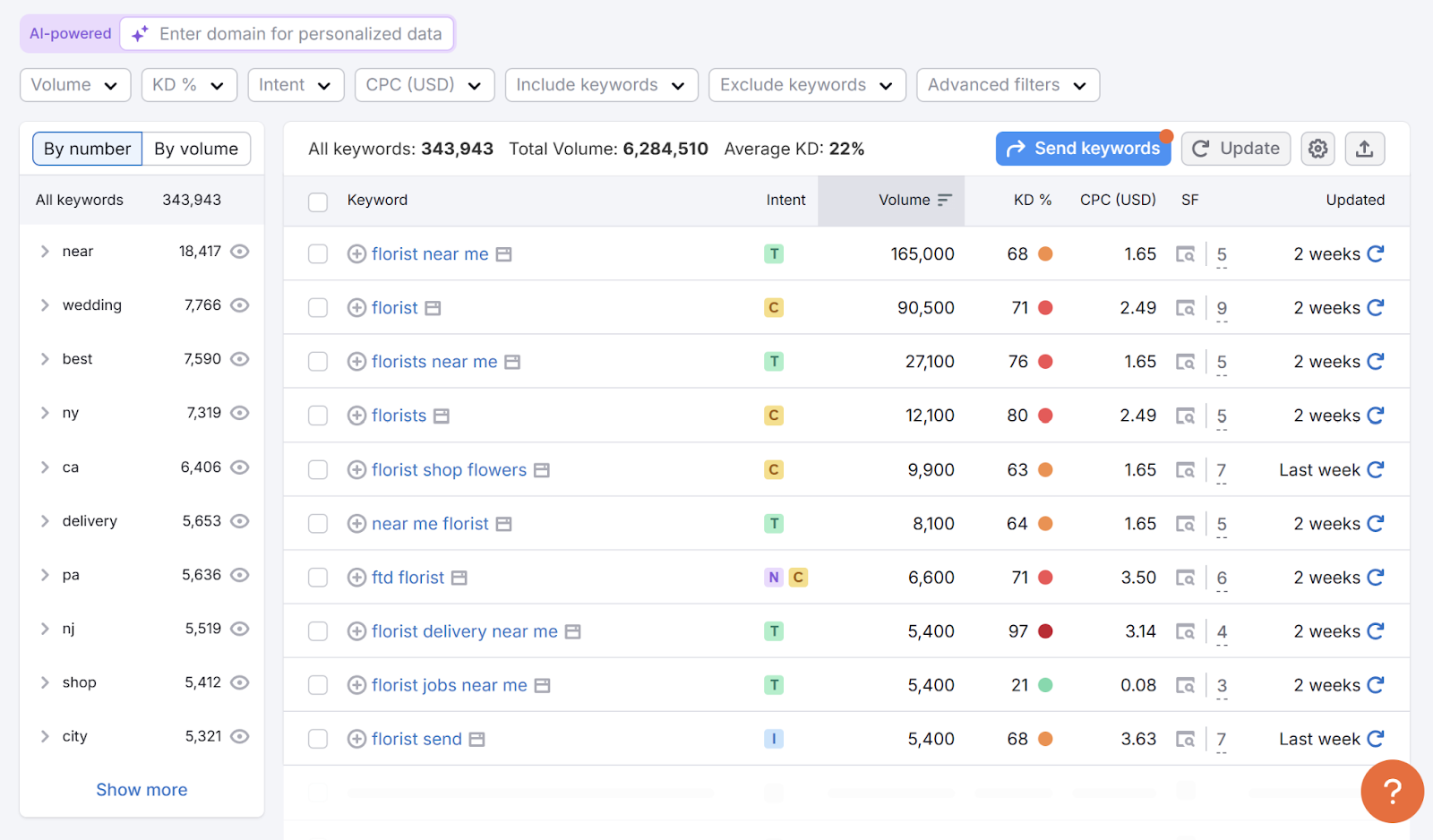
High-volume keywords — like “florist near-me” — may have thousands of competitors vying for #1. Focus on low-hanging fruit with less traffic but lower difficulty for faster victories.
Use Branded Keyword Gaps To Find Niche Angles
Some keywords include brand names, like “Nike” or “Adobe.” You might assume you can’t possibly rank for those, but they can actually help you lure away some of your competitors’ traffic. For example, you could write a comparison guide with the target keyword “Nike vs. New Balance” to attract people trying to pick their newest kicks.
Group and Categorize Target Keywords
You don’t need to write an entire piece of content for every target keyword. Look for ways to organize them, such as by:
- Search intent, like informational or transactional
- Topic, such as lawn mowing techniques and pest control tips
- Funnel stages, from awareness to decision
Want to attract people ready to buy? Focus on transactional keywords, such as “car repair near me.” For information seekers, try how-to guides or educational videos.
Build Keyword Maps To Plan Content Layout
Got a few keywords on your gotta-rank list? Figure out where they’ll fit in your site. “Dog training,” for instance, might work best in educational blog posts, while “puppy classes” belongs on a landing page.
Track Rankings and Adjust Strategy Over Time
Like a fierce sports rivalry, the great keyword competition is never really over. Competitors switch up their strategies, new rivals jump into the game (and somehow skip ahead two bases overnight), and search engines constantly refresh their algorithms.
Check your rankings every quarter with competitor keyword search tools, and don’t be afraid to experiment with new tactics if your old plays aren't cutting it.
Incorporate Insights Into Your SEO Content Strategy
Don’t just abandon all your hard-won intel after you boost your rankings. Use it to spot new content opportunities and keep the momentum going. For example, long-tail keyword variations can inspire new blog posts, and relevant keywords — like “piano finger exercises” and “piano exercise books” — could turn into topic clusters.
Bonus Tactics for Going Beyond the Obvious
So, you’ve mastered the ABCs of keyword research, but you’re still not ranking where you want to be. Here are a few expert-level tips to give you that extra competitive edge:
- Use Google Keyword Planner’s Transparency Center to snoop on competitors’ Google Ad strategies.
- Lurk on Reddit and industry forums for keyword inspiration.
- Try social listening tools like Sprout Social or BuzzSumo to find trending keywords on social media.
Turn Competitor Insights Into Results
Let's face it: Your rivals are smart, and they've got a lot to teach you. With a little competitor keyword research, you can learn new tricks and reenergize your content strategy. And don’t worry. Those other creators are almost certainly sizing you up, too.
For the biggest competitive edge, connect with the SEO pros at Compose.ly. We can help with everything from site audits to content creation, so you can get ahead.


